Security, identity, and keys
Separate tenant identity, permissions, networks, keys, and secrets at the boundaries where they are used.
Kube-DC combines organization identity, project RBAC, VPC boundaries, and project-scoped keys and secrets. A different subsystem enforces each boundary, so tenant separation does not depend on a single control.
Identity and single sign-on
- An identity realm per organization (Keycloak): each tenant organization manages its own users, groups and login policies — isolated from every other organization's.
- Single sign-on across every surface: console, Kubernetes API and CLI authenticate against the same realm via OIDC. Platform-project kubeconfigs use organization OIDC credentials; managed-cluster admin/break-glass kubeconfigs use separate per-cluster credentials.
- Group-based access: organization groups map to project roles declaratively, so joiners/leavers are handled in the directory, not in per-project role edits.
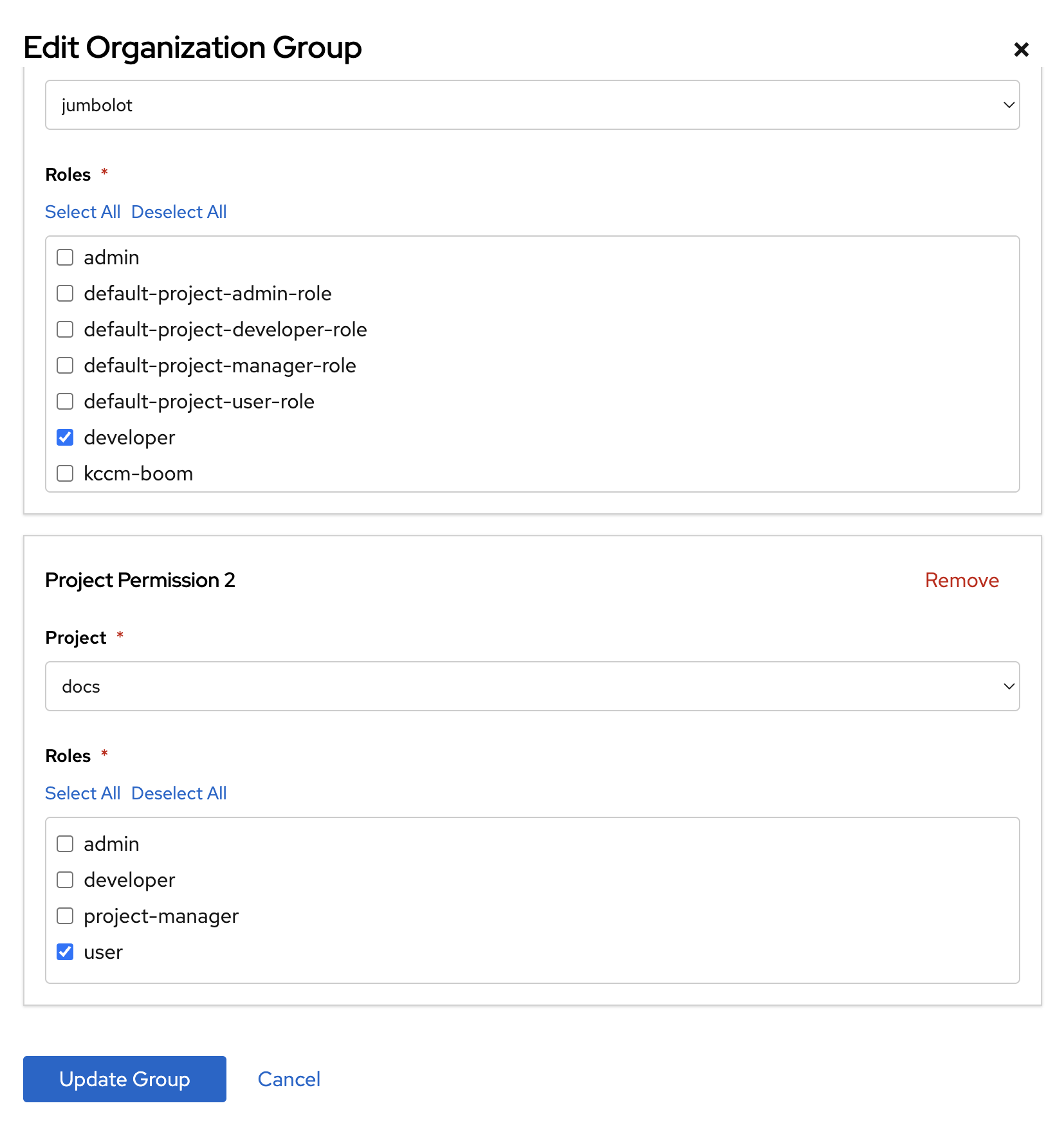
Project authorization
- A curated, supported role set per project — scoped to deploying and operating workloads. Cluster-scoped resources, CRDs and admission configuration are excluded by construction.
- Interactive
exec/attachinto pods is excluded from the supported project roles and denied by an admission policy at the API. One-off tasks run as auditable Jobs instead. Scope stated plainly: users permitted to create or modify workloads can still run code through those workloads, and the restriction does not apply inside tenant-administered managed clusters. - Custom roles remain under platform-team control; the default roles are a baseline, not a ceiling.
Key management (KMS)
- Per-project, purpose-scoped keys (
application,backup, …) backed by non-exportable keys in the platform's secrets backend (OpenBao Transit): encrypt/decrypt happens as an API operation — key material never leaves the backend. - Managed Cluster snapshot encryption can reference a Project KMS key. Managed service backup encryption depends on the family and deployment. A KMS resource alone does not prove that backup files are encrypted.
- Envelope encryption is the documented pattern for large payloads.
Secrets management
- A managed secret service per project: store API tokens, credentials and configuration secrets outside Git, with lifecycle managed through the CLI and console.
- Sync into Kubernetes Secrets: selected values project into standard Secrets that workloads consume — applications stay platform-agnostic while the source of truth stays managed.
Certificates
- Managed certificates as a project resource: public trust via ACME or issuance from your organization's private CA — the resulting TLS Secrets are consumed by workloads directly.
- HTTPS routes get their certificates automatically (see the Networking datasheet); managed-cluster public endpoints likewise.
Platform-level enforcement
- Admission policies enforce tenant boundaries at the Kubernetes API — including the pod-access block and resource-placement rules.
- Network isolation is a property of the SDN (per-project VPCs), not of tenant-managed policy.
- Egress control and allowlists are operated centrally by the platform team.
- Platform configuration can be declaratively reconciled from Git.
Responsibilities
| Concern | Your platform team | Tenant |
|---|---|---|
| Identity realms, SSO, login policy defaults | ✅ provisions | ✅ manages own users/groups |
| Project roles and admission policies | ✅ | assigns members to roles |
| KMS backend and key custody | ✅ | ✅ creates/uses keys |
| Secrets service | ✅ operates | ✅ owns contents |
| Certificates | Issuance machinery | ✅ requests/consumes |
| Workload and guest-OS security | — | ✅ |