Managed Kubernetes clusters
Each team gets its own Kubernetes API. Your platform team operates the control planes.
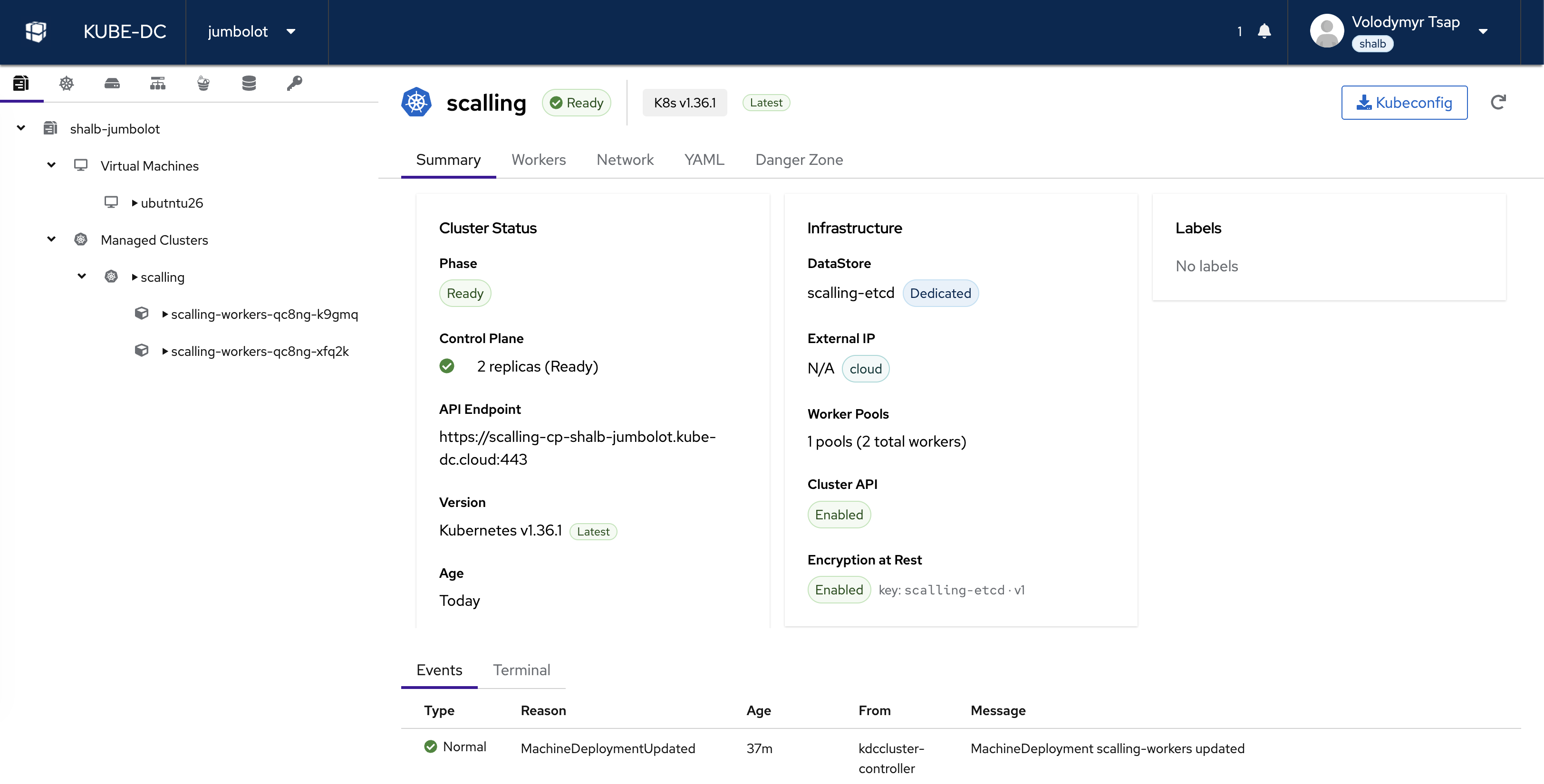
Departments, faculties, or customers can provision tenant-administered Kubernetes clusters from their projects. Kube-DC runs the control planes. Tenant administrators manage their clusters' workloads, upgrades, and access.
Architecture
A managed cluster has two parts:
- The hosted control plane runs as managed pods on the platform cluster. It includes the API server, controller manager, and scheduler, with a dedicated PKI for each cluster. Control planes use a platform-internal network that has no route from tenant networks. Tenants reach only the API endpoints published for their clusters.
- Worker pools run as virtual machines in the tenant project's VPC, beside the project's other workloads. Workers join the control plane when the cluster is created and when a pool scales up.
Clusters can share the platform datastore or use a dedicated etcd datastore. A dedicated datastore uses three replicas by default and keeps the cluster state on its own instance. The platform manages certificate rotation.
Provisioning
A cluster is one manifest (or a console form):
apiVersion: k8s.kube-dc.com/v1alpha1
kind: KdcCluster
metadata:
  name: analytics
  namespace: acme-data-platform
spec:
  version: v1.36.1
  controlPlane:
    replicas: 1            # 2+ = multi-replica topology; availability depends on deployment
  dataStore:
    dedicated: true        # own etcd instance for this cluster
  network:
    serviceCIDR: 10.96.0.0/16
    podCIDR: 10.244.0.0/16
  workers:
    - name: general
      replicas: 3
      cpuCores: 4
      memory: 8Gi
      diskSize: 30Gi
From this resource, the platform provisions the control plane, datastore,
worker VMs, cluster PKI, and kubeconfigs, then joins the workers. Deleting the
KdcCluster removes the cluster. Backup objects follow the configured bucket
and retention policy.
Endpoints and access
- Private by default. The cluster API is reachable from the owning project's VPC.
- Public HTTPS when requested. An annotation publishes the API at a stable hostname through the platform gateway, DNS, and certificate issuer. The API server certificate is reissued with the public name.
- Kubeconfigs stored as Kubernetes Secrets. The owning project receives an
admin kubeconfig for the in-VPC endpoint and, when enabled, an external
kubeconfig for the public endpoint. Tenants and CI systems can retrieve them
through the console, CLI, or
kubectl. - Independent break-glass credentials. The admin kubeconfig does not rely on platform SSO. Access still requires an available endpoint, network path, and control plane.
Worker pools
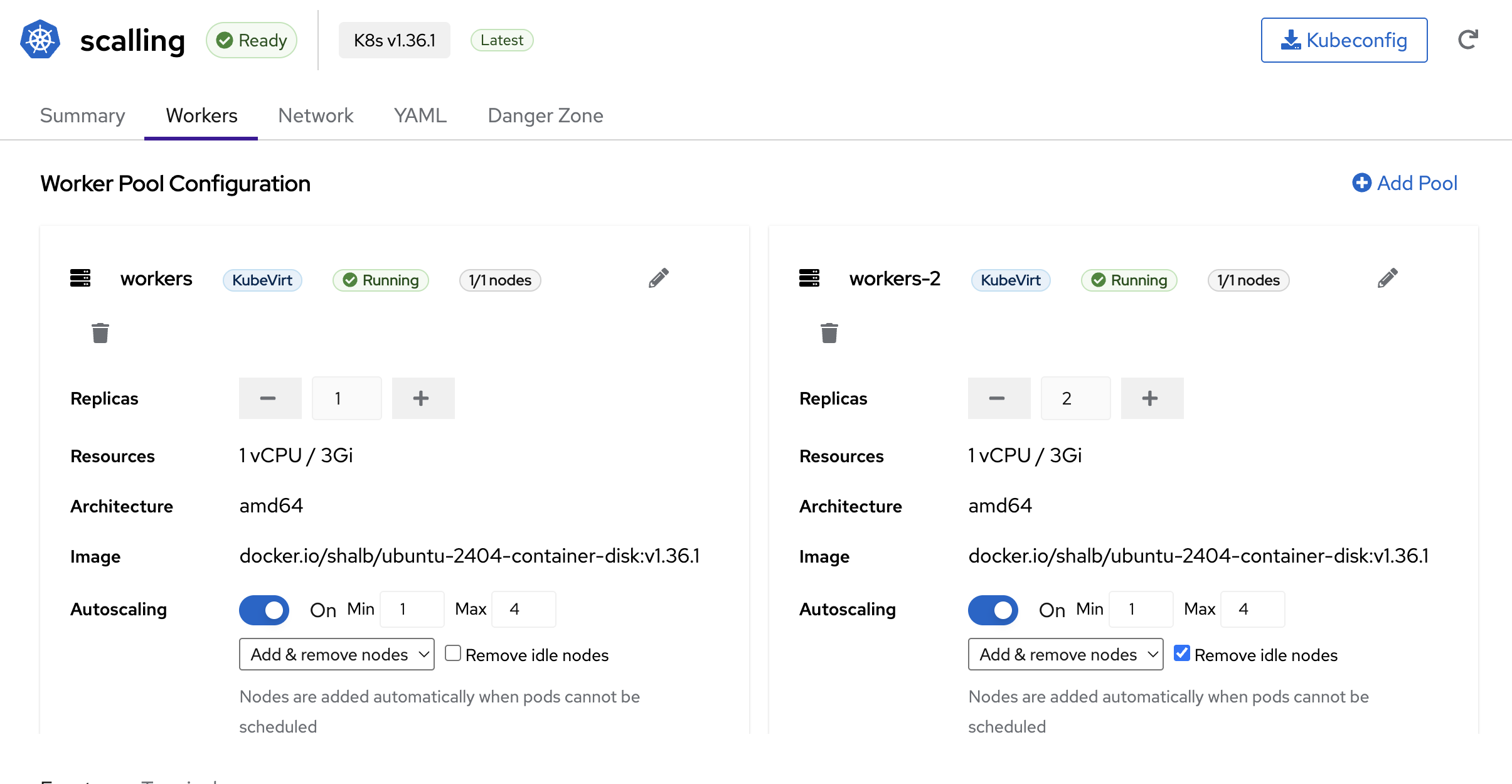
- Configure CPU, memory, disk, OS image, and replica count for each pool. A cluster can have several pools for different workloads.
- Prepared, versioned worker images are matched to the Kubernetes version.
- Per-pool autoscaling uses
minReplicasandmaxReplicasbounds, plus a maximum change per scaling event. - Rolling operations honor PodDisruptionBudgets during drains, up to the configured drain timeout.
Control-plane and etcd right-sizing
Kube-DC adjusts tenant control-plane resources within configured bounds and available platform capacity. VerticalPodAutoscalers are enabled by default for control-plane pods and etcd members:
- Resource targets follow observed load between configured floors and ceilings. Small clusters stay small, while growing clusters receive more API server and etcd capacity.
- Scaling is quorum-aware by design: recommendations are applied in-place where possible, and etcd resizing respects member quorum. Single-replica datastores use a conservative initial-assignment mode.
Upgrades
Upgrades are staged and tenant-controlled:
- The tenant (or platform team, by arrangement) sets the target version.
- The control plane upgrades first, without replacing worker nodes.
- Worker pools roll in steps — new nodes join, old nodes drain and leave, pool by pool, with PodDisruptionBudgets honored during drains.
The control plane and workers move separately. Tenants can pause after a stage, validate the cluster, and continue. Supported version skew follows upstream Kubernetes policy.
Snapshots and restore
- Scheduled etcd snapshots are enabled automatically when the project's backup bucket exists (daily by default; schedule and retention configurable per cluster), written to the project's S3-compatible storage.
- On-demand snapshots at any time — from the console or by triggering the snapshot job.
- Optional envelope encryption of snapshots with a tenant-scoped key reference; without it, snapshots are stored unencrypted.
- Self-service restore: pick a snapshot, trigger the restore, and the control plane returns with the cluster's API state rolled back to the snapshot. The tenant API is unavailable during restore.
Scope and current limits, stated plainly:
- Etcd snapshots protect Kubernetes API state; they do not protect PersistentVolume contents — protect application data through its owning service (database backups, volume snapshots, object storage).
- Restore currently supports single-replica etcd datastores; multi-replica restore is on the roadmap. For clusters using the default three-replica dedicated datastore, restore is an assisted operation until then.
Isolation and security
- Control planes run on a platform-internal network with no route from tenant networks; workers and workloads live in the tenant project's VPC.
- Each cluster has its own PKI — certificates are per-cluster, rotated by the platform.
- Inside their cluster, tenants hold full cluster-admin: their own RBAC, CRDs, operators and admission configuration, independent of the platform's project roles.
- The cluster inherits the project's network boundary: reaching a cluster's workloads from outside happens only through the exposure the tenant configures (LoadBalancer services, HTTPS routes).
Observability
When the observability stack is enabled, managed-cluster control-plane logs and events appear in the owning organization's Grafana. Tenants can inspect their API servers and controllers, while the platform team monitors all control planes centrally. The operator defines coverage and retention.
Responsibilities
| Concern | Your platform team (via Kube-DC) | Tenant |
|---|---|---|
| Control-plane operation, PKI, datastore | ✅ | — |
| Control-plane/etcd sizing | ✅ automatic, within configured bounds | — |
| Worker pool sizing and autoscaling bounds | — | ✅ |
| Kubernetes version and upgrade timing | Controllers execute the staged rollout | ✅ selects target and timing from supported versions |
| Etcd snapshots | Controllers execute scheduled snapshots | ✅ policy, on-demand runs, restore initiation |
| Workloads, in-cluster RBAC, CRDs, operators | — | ✅ |
| Application data protection | — | ✅ via managed services |
| Network exposure of cluster workloads | Platform provides EIPs/routes | ✅ configures |