Attaching a Project to a physical VLAN
Kube-DC can put a Project's workloads on a customer-owned physical VLAN, so they are layer-2 adjacent to that customer's own hardware while their default route stays on the Project VPC interface.
There are two things to operate here, and keeping them apart is the whole point:
- The wire. A
FabricSegmentis one physical broadcast domain—one (ProviderNetwork, VLAN ID) pair. You declare it once, after the switch really delivers the tag to the nodes. - Who may use it. A
FabricSegmentAllocationoffers that wire to one Organization. An Organization admin then binds it to one of their Projects, and can unassign and re-bind it without involving you.
The user-facing half of this is documented in Datacenter VLANs in the Cloud guide. For where this sits in the wider network design — overlay vs. underlay, VPCs, provider bridges — see Networking Architecture.
Supported slice
Deliberately narrow. Anything outside this is refused at admission:
FabricSegment.spec.driver: kube-ovn-underlayProjectNetwork.spec.mode: l2- a real IPv4 gateway on the customer segment
- no logical gateway, U2O interconnection, custom-VPC routing, or live VMI hotplug
- controller-assigned IP/MAC/route state; user-supplied Multus runtime overrides and provider-scoped IPAM overrides are refused
- the reserved segment may be attached only through the generated NAD, never as a
workload or Namespace primary
logical_switch - one Project per physical broadcast domain, and one Organization per wire
Enabling the feature
The chart installs the additive CRDs (FabricSegment, FabricSegmentAllocation,
ProjectNetwork, VlanReservation) on every cluster. The controller and its
fail-closed webhooks stay inactive until both fleet values are set:
PROJECT_NETWORK_ENABLED=true
KUBE_DC_MANAGER_REPLICAS=2
The chart refuses to render with one manager replica or with the manager webhook server disabled. The attachment gate is fail-closed on the pod path, so a single replica would make every rollout or drain an outage for VLAN-attached workloads. The two replicas are spread across distinct nodes and protected by a PodDisruptionBudget.
Do not set PROJECT_NETWORK_ENABLED back to false while a ProjectNetwork
exists. A live Helm/Flux upgrade and the manager both fail closed on that
transition. Delete every binding, wait for its drain-first teardown, then disable.
Prerequisites
Confirm all of the following before declaring a segment:
- The physical switch delivers the VLAN tag to every selected Kubernetes node.
- The existing Kube-OVN
ProviderNetworkis Ready on those nodes. - The customer has explicitly delegated an address range on that segment to
Kube-DC, and everything outside it is listed in
excludeIps. Reserve more than the addresses currently pingable: DHCP pools, HA/floating addresses, documented reservations and any range the customer plans to grow into. Kube-DC allocates freely from whatever you leave open, and a collision lands on equipment you do not operate and cannot see. - The VLAN CIDR does not overlap the Project's VPC subnet, nor any other VLAN the same Project holds. Nothing validates this today — an overlap produces ambiguous connected routes inside the workload and is very hard to diagnose from the outside.
- The VLAN is dedicated to one Kube-DC Project. A second Project on the same broadcast domain is refused even under another Subnet or NAD name.
- At least two schedulable manager nodes are available.
- If a Project user will attach one workload to several VLANs, at least one node carries all of them. Admission adds a required node constraint per VLAN and Kubernetes ANDs them, so disjoint ready-node sets leave the pod unschedulable.
Never reuse a platform external VLAN such as ext-cloud or ext-public. Obtain a
dedicated VLAN from the datacenter network team.
Step 1 — declare the physical segment
The name is deterministic. For the underlay driver it must be
pn-<providerNetwork>-<vlanId>, because the name is the isolation key: two
segments describing one wire collide in etcd rather than racing an admission
check.
apiVersion: kube-dc.com/v1
kind: FabricSegment
metadata:
  name: pn-ext-4014
spec:
  driver: kube-ovn-underlay
  providerNetwork: ext
  vlanId: 4014
  mtu: 1400
  nodeSelector:
    matchLabels:
      network.kube-dc.com/customer-vlan-4014: "true"
Label only nodes where the switch really delivers that VLAN. A node can have the OVS bridge up on its uplink and still receive no frames for this tag.
kubectl get fabricsegment pn-ext-4014 \
  -o jsonpath='{.status.ready}{"\t"}{.status.readyNodes}{"\t"}{.status.foreignObjects}{"\n"}'
status.ready must be true, readyNodes must match the intended nodes, and
foreignObjects must be empty. foreignObjects lists kube-ovn objects sitting on
this wire that Kube-DC did not create — an alias Subnet or duplicate Vlan can
bridge an unintended Project onto the same broadcast domain, so it blocks admission.
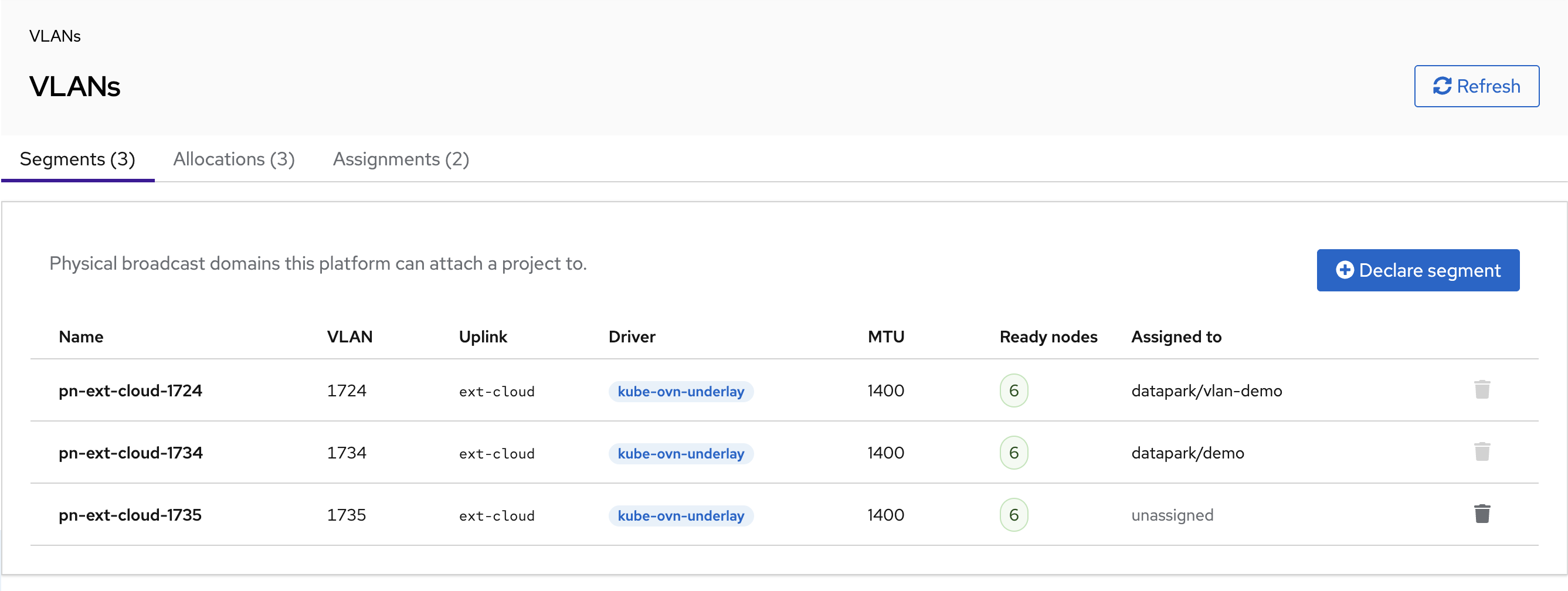
Segments and their allocations are visible under Infrastructure → VLANs in the admin console.
Step 2 — allocate the wire to an Organization
This is what delegates day-to-day assignment to an Organization admin. Use Infrastructure → VLANs → Allocations → Allocate to Organization.
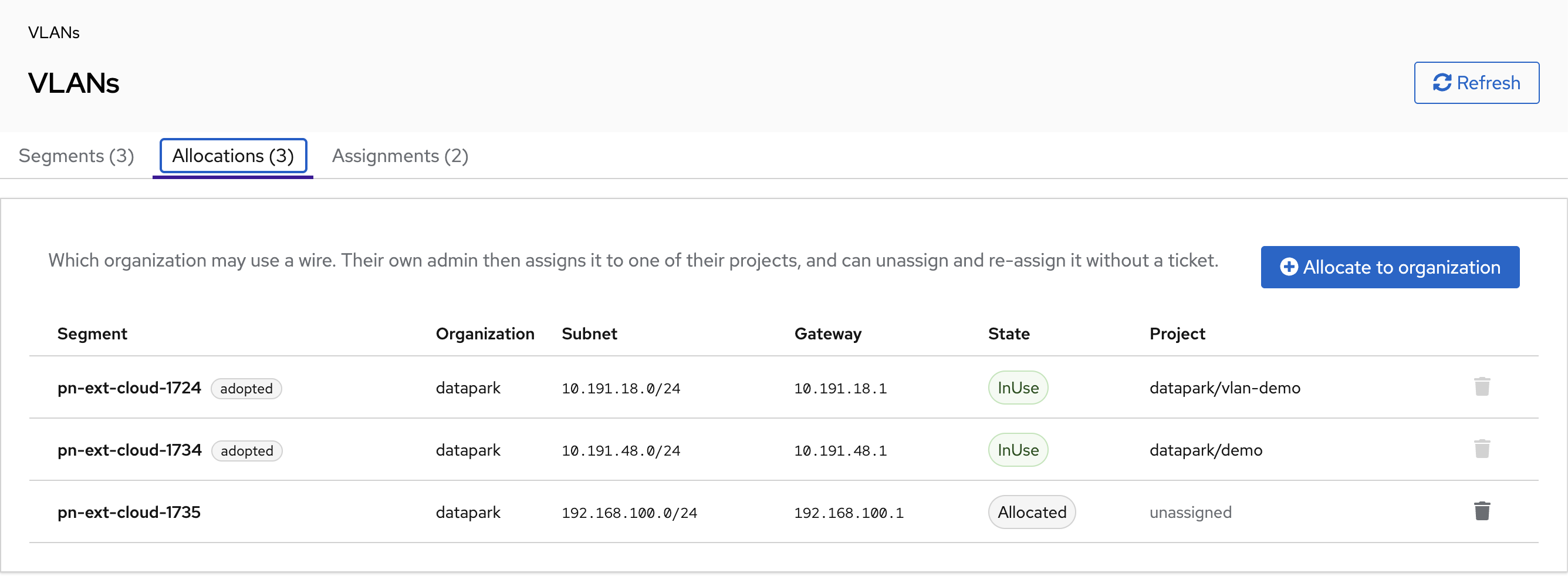
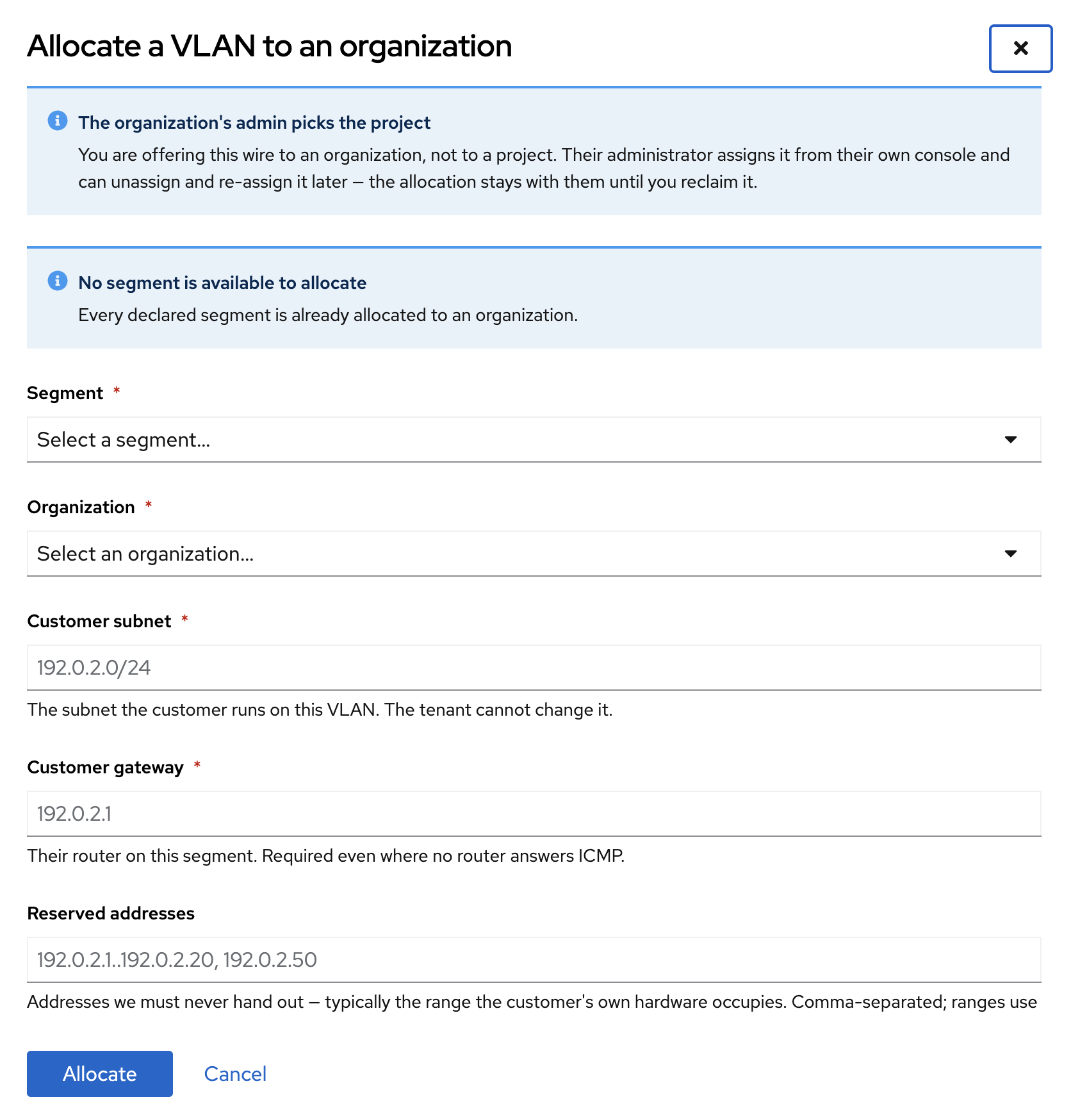
Or by manifest:
apiVersion: kube-dc.com/v1
kind: FabricSegmentAllocation
metadata:
  name: pn-ext-4014          # MUST equal the FabricSegment name
spec:
  org: acme
  network:
    cidrBlock: 192.0.2.0/24
    gateway: 192.0.2.1
    gatewayCheck: false
    excludeIps:
      - 192.0.2.1..192.0.2.99
Two things about this object are load-bearing:
Its name is the segment name. There is no segmentRef field, and adding one
would be a regression. Naming the allocation after the wire makes "one
Organization per broadcast domain" an atomic property of storage — a second
allocation collides with AlreadyExists. A segmentRef field plus a uniqueness
check in admission is a read-then-write race: two concurrent passes each list,
each see no conflict, and both proceed.
The addressing lives here, not on the Project binding. These are physical
facts about the customer's segment, and admission requires an Organization-admin-created
ProjectNetwork to match them exactly. Without that, an Organization admin — who holds
create on ProjectNetwork — could bind their allocated wire with a CIDR
covering the customer's entire subnet, a gateway pointing at their own workload,
or empty excludeIps that lets IPAM hand out addresses the customer's hardware
already uses.
spec.network stays editable while the wire is unassigned, so a mistyped gateway
is a patch rather than a rebuild. An existing binding copied the values at
creation and is unaffected.
kubectl get fabricsegmentallocation
# NAME          ORG    PHASE       PROJECT   SEGMENT READY   AGE
# pn-ext-4014   acme   Allocated             true            2m
| Phase | Meaning |
|---|---|
Allocated | The Organization holds it; no Project has taken it. |
InUse | A Project holds it. |
Releasing | The binding is draining. Not yet re-assignable. |
Step 3 — an Organization admin binds a Project
Nothing for you to do. The Organization admin assigns and unassigns from their own console, as described in Datacenter VLANs.
The controller claims the segment with a VlanReservation, creates the Kube-OVN
Vlan and Subnet, and publishes the NAD last. Do not create or edit those generated
objects by hand.
kubectl get projectnetwork
kubectl get vlanreservation pn-ext-4014 -o yaml
kubectl -n acme-production get network-attachment-definition
Binding directly, as the platform admin
You can still create a ProjectNetwork yourself — for a cluster where nobody has
delegated yet, or to reproduce a Project user's issue:
apiVersion: kube-dc.com/v1
kind: ProjectNetwork
metadata:
  name: customer-storage
spec:
  org: acme
  project: production
  segmentRef: pn-ext-4014
  mode: l2
  cidrBlock: 192.0.2.0/24
  gateway: 192.0.2.1
  gatewayCheck: false
  excludeIps:
    - 192.0.2.1..192.0.2.99
A platform admin may bind without an allocation existing. The controller then adopts one — recording which organization holds the wire, copying the addressing off the binding. That is how clusters that predate this feature converge with no migration step and no operator action.
Adoption only ever creates; it never rewrites an allocation that disagrees, and it
only adopts a binding that already holds the segment's VlanReservation. Both
restrictions exist so a binding cannot re-home a wire behind your back.
Security model
Delegation gives Organization administrators narrowly scoped cluster-level verbs on ProjectNetwork. RBAC
cannot express "only your own organization" for a cluster-scoped kind, so RBAC
is only a coarse gate and admission is the real boundary.
The delegated Organization ClusterRole
kube-dc:projectnetwork-tenant grants exactly create and delete, bound
per-organization to the group <org>:org-admin. Do not add verbs to it.
- No
update/patch. EveryProjectNetworkSpecfield is immutable, so an Organization administrator UPDATE can only touch metadata — including the controller's teardown finalizer. Strip that and delete, and the binding disappears without draining: the NAD and reservation go while a workload's Multus interface is still on the wire, the allocation reads free, and the next assignment puts two projects on one L2 segment. The webhook denies user UPDATEs independently, but do not rely on that alone. - No
get. Binding names are predictable (<segment>-<project>) and admission cannot filter a read at all, so a cluster-scopedgetwould let any Organization admin read another Organization's Project names, subnets and gateways.
The cost is that Organization admins can kubectl create -f and kubectl delete <name> but
not apply or get; the console serves their reads, filtered.
What admission enforces
On ProjectNetwork CREATE / UPDATE / DELETE:
- the caller is a platform admin, or carries
<spec.org>:org-admin; - the live
OrganizationUID matches the one pinned on the allocation; - an allocation exists for the segment, is not being reclaimed, and names that Organization;
- the binding's addressing matches the allocation exactly;
- the Project exists in that Organization;
- the segment is not already bound;
- no user UPDATE, ever.
Identity comes from AdmissionRequest.UserInfo.Groups, which the API server
derives from the authenticated token. Per-organization OIDC stamps the realm name
onto every group, so acme:org-admin can only be issued by the acme realm — a
user cannot mint a group naming somebody else's Organization.
DELETE is validated too, and this is easy to miss: a cluster-scoped delete takes
a name, and other Organizations' binding names are guessable. Without the rule, any Organization
admin could tear down another Organization's VLAN grant.
Organization names are not identities
Names are reusable. Delete acme, create it again for a different customer, and
the new realm mints the identical acme:org-admin. The controller therefore pins
the Organization UID in status.orgUid and admission compares the live UID
against it.
On mismatch the allocation is marked stale and the pin is not rewritten — re-pinning is exactly the silent hand-over being prevented. Re-allocate explicitly. The console shows a warning icon on such a row.
Limits worth knowing
- In-cluster ServiceAccounts cannot assign VLANs. Authorization derives from the realm-prefixed OIDC group, which only human Organization admins carry. GitOps driven from inside a Project backing namespace cannot bind a wire; assignment is a human, audited action.
- Anyone holding
impersonateon groups can forge<org>:org-admin. That is cluster-admin territory and no Project Role grants it, but the group check is exactly as strong as the set of principals allowed to impersonate. - Deleting the CRD removes stored allocations without per-object admission.
Reclaiming a wire
Deleting an allocation is refused while a project still holds it, both at
admission and by a finalizer — so the refusal survives a webhook outage or a
--force delete.
kubectl delete fabricsegmentallocation pn-ext-4014
# Error from server (Forbidden): admission webhook
# "vfabricsegmentallocation.kube-dc.com" denied the request:
# tenant-VLAN attachment denied: allocation "pn-ext-4014" is still assigned to
# project "production"; unassign it and let the wire drain first
Ask the Organization admin to unassign, or delete the ProjectNetwork yourself, wait for
teardown, then reclaim. In the console, Reclaim is disabled while a Project
holds the wire and the tooltip names that Project.
Teardown
Delete the ProjectNetwork — never its NAD, Subnet, Vlan, or reservation.
Teardown enters Denying, refuses new attachments, and waits for a stable zero of
attachment intent. It then confirms, in order, that the NAD, Kube-OVN Subnet
(including its finalizer) and controller-owned Vlan are gone before releasing the
reservation.
kubectl delete projectnetwork customer-storage
kubectl get projectnetwork,vlanreservation
If deletion waits, remove the pods and VMs that still declare the NAD, and inspect
kubectl get ips.kubeovn.io -o yaml for allocations whose spec.subnet or
spec.attachSubnets names the generated Subnet. Teardown waits for both declared
intent and realised Kube-OVN allocations. Do not remove the finalizer.
Delete the FabricSegment only after the reservation is released and the
ProjectNetwork is gone.
Orphaned reservations
A VlanReservation whose owning ProjectNetwork no longer exists blocks every
future binding of that wire and blocks deleting the segment — and the fabric
guard correctly refuses a reservation delete from anyone but the controller, so it
cannot be cleared by hand.
The controller reaps such a claim automatically, but only when the wire is
genuinely quiesced. On reconcile it compares the reservation's owner UID against
live ProjectNetworks and, if the owner is gone, additionally confirms that
teardown's own artifacts — the published NAD and the generated Kube-OVN Subnet —
are absent before releasing anything.
That second check is the important one. A ProjectNetwork can disappear without
its drain-first teardown ever running: force-remove the finalizer and the object
goes while its NAD, its Subnet and every attached interface survive. Releasing the
reservation there would turn a stuck wire (fail-safe) into a re-assignable one
(fail-open), and the next binding would put a second project onto a broadcast
domain that still carries the first project's workloads.
reaping orphaned VlanReservation: owner gone and teardown artifacts confirmed absent
If instead you see this, the wire is quarantined on purpose:
NOT reaping VlanReservation: its owner is gone but teardown artifacts remain —
the wire may still carry workloads
Do not clear it by hand. Find what is still attached, remove it, and let the remaining NAD and Subnet go; the reaper then releases the claim on its next pass.
Never force-remove a ProjectNetwork finalizer. It is what makes teardown
drain-first, and skipping it is the one way to leave live interfaces on a wire the
platform believes is free.
If a wire seems permanently stuck, check for a reservation with no matching binding before doing anything more invasive:
kubectl get vlanreservation -o custom-columns=\
'NAME:.metadata.name,OWNER:.spec.owner.name,UID:.spec.owner.uid'
kubectl get projectnetwork -o custom-columns='NAME:.metadata.name,UID:.metadata.uid'
Attaching workloads
Project-user instructions are in Datacenter VLANs. What matters operationally:
Admission injects required node affinity and provider-scoped port security,
re-deriving usable nodes from live Node and ProviderNetwork state — so a stale
FabricSegment.status.readyNodes cannot authorize a black-holed placement. For
VMs this happens on the generated virt-launcher Pod, not on the
VirtualMachine object.
A live Pod/VMI attachment set is immutable. Recreate the Pod, or stop the VM and update its template, so admission and CNI run in order. Live VMI network hotplug to a new Project VLAN is refused, and live migration is not supported for VLAN-attached VMs.
Refusals name which of three problems occurred: a namespace backing another Project, a VLAN not assigned to this Project (with the valid assignments listed), or unsupported custom networking. A support ticket from a Project user usually contains enough detail to identify the cause.
Acceptance
A runnable smoke test
Project admission blocks kubectl exec, including for platform OIDC
administrators. Run the checks inside a short-lived Job and read the results
from its logs. The command discovers the VLAN interface from the target route;
it does not assume the attachment is net1.
NS=acme-production
kubectl delete job -n "$NS" vlan-check --ignore-not-found

kubectl apply -f - <<'EOF'
apiVersion: batch/v1
kind: Job
metadata:
  name: vlan-check
  namespace: acme-production
spec:
  backoffLimit: 0
  template:
    metadata:
      annotations:
        k8s.v1.cni.cncf.io/networks: acme-production/pn-ext-4014-production
    spec:
      restartPolicy: Never
      containers:
        - name: check
          image: nicolaka/netshoot
          env:
            - name: TARGET
              value: 192.0.2.1
          command: ["/bin/sh", "-ec"]
          args:
            - |
              IFACE="$(ip route get "$TARGET" | awk '{for (i=1; i<=NF; i++) if ($i == "dev") {print $(i+1); exit}}')"
              test -n "$IFACE"
              echo "VLAN interface: $IFACE"
              ip -4 -br addr show dev "$IFACE"
              ping -c3 -I "$IFACE" "$TARGET"
              ping -c1 -M do -s 1372 -I "$IFACE" "$TARGET"
              if ping -c1 -M do -s 1500 -I "$IFACE" "$TARGET"; then
                echo "unexpected success above the configured MTU" >&2
                exit 1
              fi
              echo "oversized DF packet failed as expected"
EOF

kubectl wait -n "$NS" --for=condition=Complete job/vlan-check --timeout=120s
kubectl logs -n "$NS" job/vlan-check
kubectl get pod -n "$NS" -l job-name=vlan-check \
  -o jsonpath='{.items[0].metadata.annotations.k8s\.v1\.cni\.cncf\.io/network-status}'
echo
kubectl delete job -n "$NS" vlan-check
Run the same Job on a second VLAN-capable node by adding nodeName under the
Pod template's spec. Use a target on the other node to prove cross-node
traffic on the segment.
Delete the test Job before unassigning the wire. Teardown blocks on any remaining attachment intent, and its leftover Pod will look like a stuck unassign.
Full checklist
Before presenting the feature as operational on a cluster, prove all of these:
- a pod and a VM attach and communicate across two different VLAN-capable nodes;
- an MTU-sized DF packet succeeds and a larger one fails as expected;
- a pod pinned outside the segment's ready nodes is denied;
- another project cannot reference the NAD, an alias Subnet, a conflist provider, or a direct logical-switch selector;
- an owner workload cannot select the reserved Subnet as its primary switch or supply its own Multus/provider IP, MAC, route or default-route values;
- removing the network annotation from a live Pod/VMI is denied;
- a second
ProjectNetworkcannot claim the segment, and a directVlanReservationmutation or deletion is denied; - an Organization admin cannot bind a segment allocated to another organization, delete another organization's binding, allocate a wire to themselves, alter the addressing, or bind a wire that is already held;
- unassign followed by re-assign to a different project succeeds, and the allocation survives both;
- ordinary pods with no secondary network still admit while the webhooks are on;
- a manager rollout preserves at least one webhook endpoint;
- no U2O/custom-VPC/routed fields exist on the generated Subnet;
- a terminating Pod and a surviving Kube-OVN
IPallocation both keep teardown blocked until they are genuinely gone; - a reservation whose owner was force-deleted is NOT reaped while its NAD or Subnet remain.
Related
- Datacenter VLANs — the Project-user guide
- External Networking — provider networks and platform VLANs
- Networking Architecture — how Kube-OVN is laid out